Gold Prospecting Equipment and Gold Panning Supplies and Gold Mining Equipment
CLICK to SEARCH
Huge Selection of Gold Prospecting Equipment & Supplies
  
New To Prospecting?
Gold Pans & Gold Panning Kits
Alaska Paydirt
Gold Classifiers
Earthquake Classifier
Spiral Gold Panning Machines
Desert Fox Gold Panning Machine
Pro Camel 24 Gold Panning Machine
Sluice Boxes
Power Sluice - High bankers
Vortex Drop Riffle Sluice Box
CC 690 Power Sluice
Gold Trommels
Mountain Goat Gold Trommel
Big Green Trommel
Pro Gold Trommel
Trommel Classifier
Gold Dredge - Dredging
Hand Dredges - Recover gold from streams FAST!
Gold Drywashers & Accessories
Vac Pac
Rock Crushers
Fine Gold Recovery
Gold Cube Sluice
Blue Bowl Concentrator
Catch It II - Gold Collecting Water Table
Gold Hog Mats
Gold Smelting | How to melt gold
Gold Testing Kits
Gold Prospecting Picks, Shovels & More
Gold Prospecting Accessories & Supplies
Gold Prospecting Books
Gold Prospecting Maps
Metal Detectors & Metal Detector Accessories
Buy Gold Nuggets
Rock Hounding Supplies
The Original Woodman's Pal Machete - Super Low Prices!
Snake Bite Protection
Knives
Survival & Emergency Supplies
Product Videos
Links/Resources
Gift Certificates
Shipping/Returns
Gold Prospecting Articles
Gold Prospecting Blog
Affiliate program
About/Contact Us
Privacy Policy

facebook
"Like us on Facebook!
Join Us on Facebook! Are you on Facebook? If so, please "Like" our page where we post helpful tips, special sales, industry news, and brag about YOU and your success!
treasure hunting
gold prospecting
Online Payments
Facebook
Add to favorites
Digg
Delicious
 
 New To Prospecting 
prospecting equipment
Got questions about gold prospecting?
Are you new to gold prospecting? You know you'd like to give it a try, but don't know where to start? Most people begin with the most basic of all prospecting equipment — the gold pan. We recommend a plastic pan instead of a metal one, but it's really a matter of personal preference. Plastic, of course, is light weight and nearly unbreakable, so it'll last forever and your arm won't get tired as quickly. Remember, you are adding water, dirt, and gravel to your pan, so it can get heavy quickly. You might want to begin with a couple different sizes of gold pans (10 inch, 12 inch, and 14 inch are the most popular) until you know which feels the most comfortable in your hand.

Plastic pans generally come in green, black, and blue. The color doesn't effect performance, but green is the most common. Color is a matter of personal preference. Some swear gold flakes show up better against a black pan, others say they like green or blue because the magnetic black sand that usually accompanies gold blends into a black pan, whereas they want it to stand out for easy removal. Some pans are round, others are square, or even hexagonal in shape.

Before using a brand new plastic pan that still has some "shine" to it, remove that shine to stop fine gold from potentially floating out of your pan. The shiny surface is a releasing agent (mostly oil) from the manufacturer. A good liquid dish detergent, water, some dirt or sand, or a scouring sponge is all you need to "season" your pan. Just scrub the insides of your pan until water no longer beads up, and you are ready to go!

Practice makes perfect in just about everything and it is no different when it comes to gold panning. Luckily you can practice in your kitchen or laundry sink so that when you head outdoors, you'll already have your technique down and panning will go faster. All you need to practice is your pan and gold bearing dirt. Watch the video below to see an example of how to properly gold pan. Then, try it yourself. One of the best things about gold panning is that it can be exciting for all ages — kids and adults!
gold prospecting
Gold Panning Kits
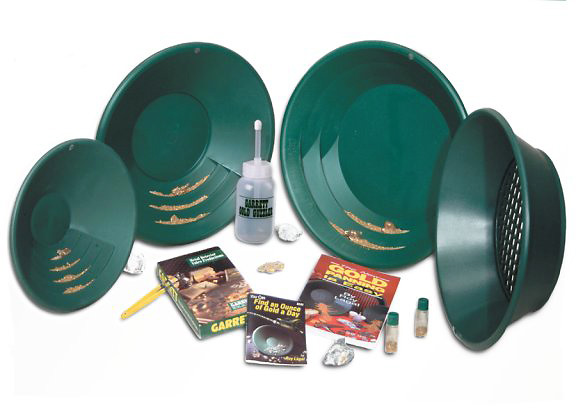
The most economical way to get started gold prospecting is to purchase a gold pan kit .A gold panning kit contains all your must-have gold panning basics and a few extras: a couple different sizes of pans, classifiers, tweezers for picking up pieces of gold, a snuffer bottle to suck up tiny pieces of gold, vials to put your finds in, and instructional, how-to information.  A rock pick and a treasure scoop also come in handy to first break up soil and rocks, then get it into your pan. Gold panning champion Don Robinson's DVD is an excellent resource for learning the proper technique of gold panning.
Sluice Boxes
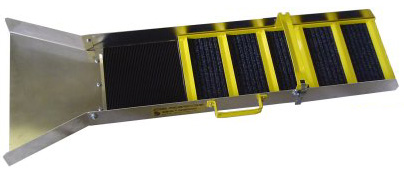
After learning to gold pan, prospectors usually step up to a sluice. Sluices can process a lot of material in a day and provide really efficient gold recovery. After your basic gold pan, it can't be beat among non-powered, hand-fed equipment. A sluice uses the force of running water to do the same thing a gold pan does — just quicker and in much larger volume. The idea is to position a sluice box in running water so that the force of the water does the work of separating the dirt and rocks away from the gold. Since gold is heavy, it will stay in the bottom of the sluice, trapped in the miner's moss or matting. A power sluice or highbanker really ramps up your ability to recover gold even more!
   
 
Classifiers
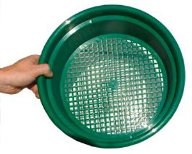
Classifiers, also called sieves or screens, go hand in hand with a gold pan. Designed to fit on the top of 5 gallon plastic buckets used by most prospectors, and over most gold pans, the classifier's job is to screen out larger rocks and debris before you pan the material. Classifiers come in a variety of mesh sizes. The mesh refers to the screen size. For example, a 1/2 inch mesh is about 4 holes per square inch; a 1/4 inch mesh has about 16 holes per square inch; 1/8 inch contains about 64 holes per square inch and so on. 1/100 inch is the smallest mesh that is commonly used for microscopic gold recovery and ultra fine gold dust and flakes.
Spiral Panning
Machines
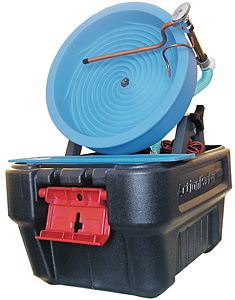
After mastering panning, classifying and sluicing, many prospectors want to recover gold easier and faster so they step up to an automatic spiral panning machine, a Gold Cube, a highbanker/dredge. A drywasher is used in arid and desert areas where water is not readily available. These items recover gold in different ways, but are more efficient and effective at getting the shiny stuff than what you can generally do panning by hand. Although these items are a few hundred dollars each, at today's gold prices, you don't need to find very much to completely pay for your equipment (which is built to last), and the rest is pure profit!  Gold miners who do this more for a living than just a hobby invest in gold trommels.
panning for gold
Where to Find Gold
After wondering about how to get started gold prospecting, your next question might be, "Where can I find gold?"  The simple answer is if you know where gold has been found in the past (the Mother Lode area in California, for example) that usually means you'll find gold there again. Since streams are always changing, gold washing down from mountains or other gold bearing areas is always changing, too. Storms, floods, or man-made changes to a waterway all affect where you'll find gold. A great number of topo maps and books have been written on how and where to find gold, so doing a little research on the state where you live or where you plan to prospect will greatly increase your chances.

Modern day prospectors have better equipment than the '49s of yesteryear, so even if an area was worked 100 years ago, those old-timers probably didn't get every bit of gold. And again, Mother Nature is always moving boulders, tearing up tree roots, and otherwise moving gold around. After a storm or following the spring snow melt are some of the best times to look for gold because the increased volume of water can move a lot of things around and cause "stuck" gold to get "unstuck" and flow down a river, stream, or creek where you can now recover it.

Recreational gold prospectors can try their luck on public lands and waterways in most states, but first check with your local national park office or Bureau of Land Management to be absolutely sure where you can do so. If you join Gold Prospectors Association of America (GPAA) members can visit any of the club's claims in any state for free, so you'll always have a legal place to prospect and other members to talk to.
Gold Prospectors Association of America
There's nothing like a little camaraderie, so joining an online forum or a club in your area is a great idea. It's amazing that when a group of like-minded prospectors get together — old timers and newbies alike — what you can learn. If you have a question, organizations like Gold Prospectors Association of America are filled with knowledgeable members.

Online forums such as GoldProspectorsSpace.com are also great places to "meet" other gold miners over the Internet. Most everyone is eager to share their knowledge, expertise, and opinions on prospecting equipment they have used.

Remember, with the price of gold on the rise, there has never been a better time to join the modern-day Gold Rush! You don't need to find much gold to completely pay for your supplies and equipment, and the rest is pure profit. And besides that, gold prospecting is a fun family activity in the great outdoors that can be enjoyed by all ages. So what are you waiting for? Get out there and get your share of the gold!
Gold Prospecting, Gold Mining, Metal Detecting, Treasure Hunting, Woodman's Pal Machete and More!

Thanks for visiting today to learn about gold mining, where to find gold, and how to find gold, plus metal detectors and gold panning and gold mining equipment for placer mining. You will find a wide variety of gold panning equipment and gold panning supplies and learn how to pan for gold if you are just getting started. Additional  prospecting equipment such as a gold dredge, drywashers for the desert, highbankers, the Mountain Goat gold trommel and the larger Pro Gold Trommel, the Gold Cube, power sluices, and hand dredges and Microwave Gold Smelting Kilns and Kits are all here. Want rich Alaskan paydirt delivered to your doorstep? Also shop for the CC690 power sluice, the Catch It II Water Table for fine gold recovery, and panning machines that make traditional panning for gold go faster and easier. We also sell round hounding supplies and outdoor necessities such as the Woodman's Pal machete, and snake bite protection. Looking for information on metal detecting and treasure hunting or need a gold detector for finding gold? Do you want to shop for a Bounty Hunter metal detector, a Garrett detector, a Fisher metal detector, a Tesoro detector, or a Teknetics metal detector? You may also want to read articles about prospecting, historic sites, and ghost towns.